Light reaches the layer
Suitable blue light from the screen or surroundings reaches the quantum dots inside the film.
A red light screen protector with a quantum-dot optical layer that turns part of incoming blue light into red light. Tempered glass for your everyday screen. No charging required.
How it works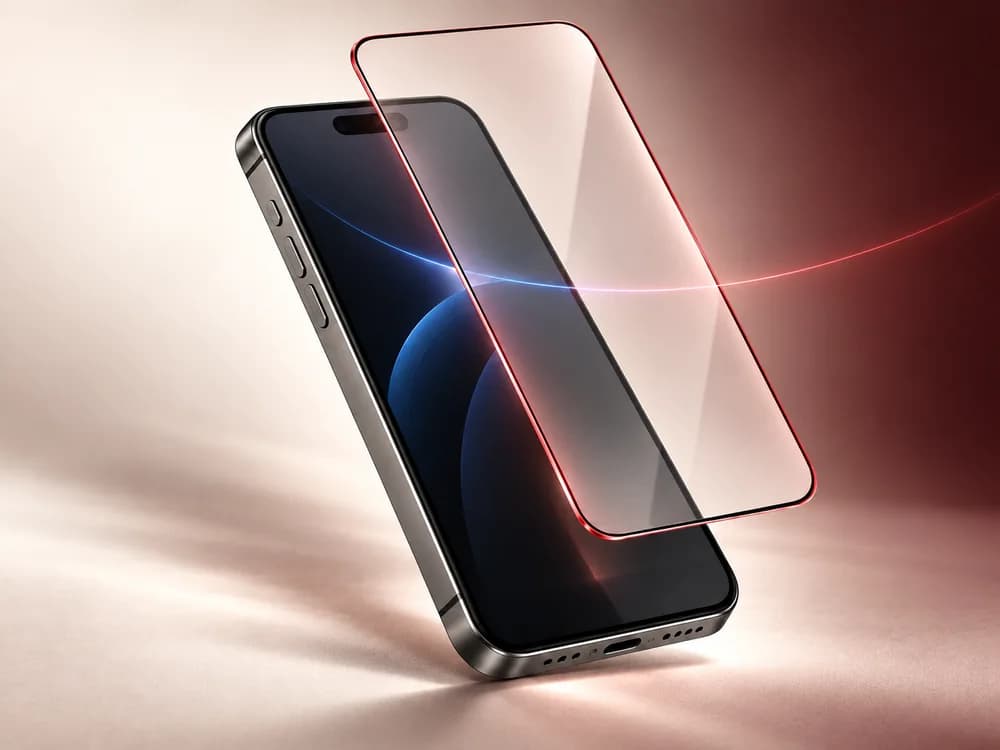
Tiny particles called quantum dots absorb some incoming light and emit it at a longer wavelength. This process is called photoluminescence.
Suitable blue light from the screen or surroundings reaches the quantum dots inside the film.
The particles absorb part of that light and re-emit it as red light. The amount depends on the light reaching the material.
The emitted light travels in several directions. Some reaches the edges, where it may be visible under suitable lighting.
A thin quantum-dot layer sits between supporting film layers. It responds to light reaching the material, so there is no battery to recharge or extra app to open.
Tempered glass adds everyday scratch protection. An oleophobic finish makes fingerprints easier to wipe away. The optical layer and protective surface do different jobs in one accessory.
Choose your complete iPhone model name, then follow your kit’s cleaning and alignment steps. Check the touch response and case clearance after installation.
Clean. Align. Apply. ↗Similar names can describe different approaches to light.
An optical material absorbs some incoming light and emits light at a different wavelength.
A filter reduces transmission in selected wavelengths. Filtering alone does not mean blue light is converted to red.
A display setting changes the light produced by the screen. It does not add a physical protective layer.
HUIBAO material technical notes, based on sheets dated June 8, 2026. These specifications describe the named base films; the complete protector also includes glass and adhesive layers.
| Property | E60-01 | E90-02 |
|---|---|---|
| Red emission peak | 630 ± 5 nm | 650 ± 5 nm |
| Emission FWHM | ≤ 45 nm | ≤ 45 nm |
| Transmittance | ≥ 87% | ≥ 87% |
| Haze | ≤ 2% | ≤ 2% |
| Base-film thickness | 60 ± 5 μm | 90 ± 5 μm |
Transmittance and haze: ASTM D1003. Peak wavelength and emission width: luminance-meter method stated in the technical sheets. Base-film thickness is not the total thickness of a finished screen protector.
Explore the E60 and E90 base-film grades, the PET and OCA constructions, and how quantum dots turn part of incoming blue light into red light. Our material guide explains the specifications in English and connects them to the questions that matter when choosing your iPhone protector.
Explore HUIBAO materials and technology ↗